The homeowner phrase vs the system in the room
Cellar tanking, in conversation on King Lane, covers three very different walls:
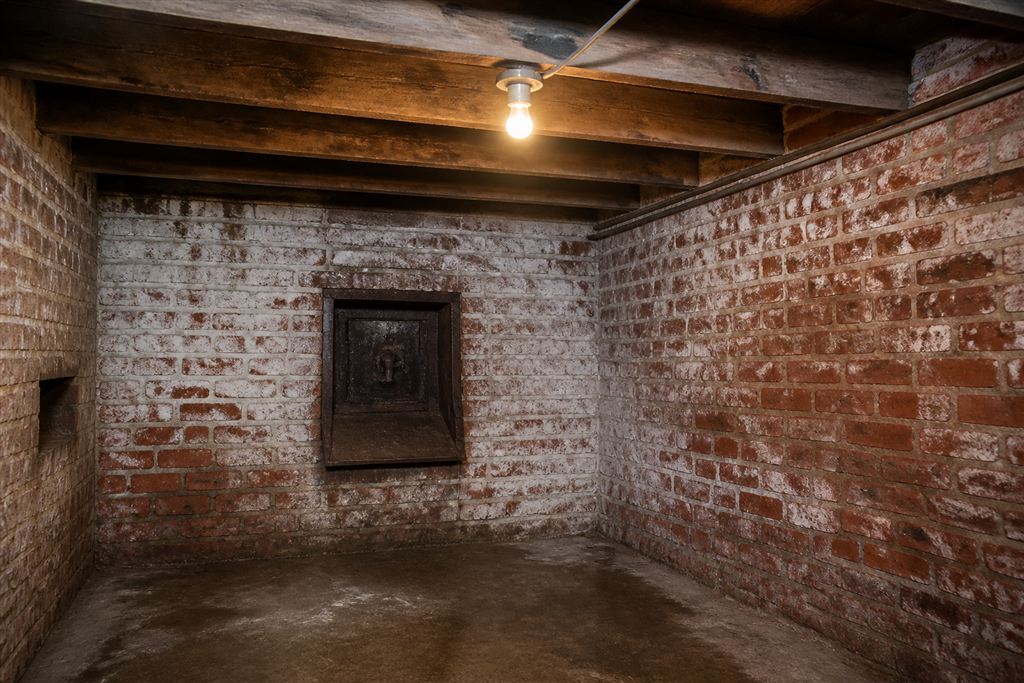
| What you can see now | What it usually is in an Alwoodley semi | What we do after survey | |---|---|---| | Smooth grey coat, hollow in places, white salts at the base | Cementitious Type A slurry on original brick | Strip the failed coat at the wet zone; do not overlay and trap water against a party wall | | Black, sticky, crumbling behind shelves | Old bitumen / tar tanking, often from a 1970s–90s “damp man” | It is not a cavity. It comes off where it has lost bond. We do not paint membrane over tar and call it Type C | | Bare brick, damp to the touch after rain, no coat | No previous tanking; clay groundwater or a dead land drain | Specify Type C if the room is used; do not sell a slurry job because the search phrase said tanking |
Alwoodley Cellar Waterproofing does not sell a “cellar tanking service” as a synonym-spin of the other spine page. If the honest spec is cavity drain, we say cellar tanking is the search; Type C is the install. Type C for Alwoodley cellars

Diagram — BS 8102 types in plain English. Illustrative, not a site photo.
Why slurry fails on this particular wall
Alwoodley Park and Primley Park coal cellars have:
- a party wall that moves with the semi next door — slurry is a brittle skin
- a coal-chute reveal or a later blocked opening — a corner slurry never details properly
- clay that wets and dries with the seasons, plus Alwoodley Beck’s wet ground feeding toward King Lane — hydrostatic pressure the coat was never designed for
- original lime pointing in places, which does not like a dense cement face
A citywide damp visit that “tanked” the cellar ten years ago and is now staining again is a common Alwoodley story. We do not need a fake case study to say the pattern: barrier on a small interwar room, no drained outlet, salts returning at the floor joint.
Overlaying new slurry on old slurry is how you hide the problem until the next winter. The discovery survey’s job is to say strip or leave, not to sell another coat.
Type C when “cellar tanking” is what you typed
Cavity drain does not ask the 1930s brick to be watertight. Water that arrives is guided to a channel and a sump. That is why it is the default on this stock after a failed Type A coat.
Limits, said plainly:
- If the cellar is a dry cupboard under The Fairway and you only searched the phrase, we will not specify a system.
- If old bitumen is the only lining and the room is a future conversion, stripping and replacing with a drained membrane is recorded now so you do not cut it out later. Conversion after waterproofing
- If the house is on the 1970s golf-course streets and has no cellar, cellar tanking is the wrong query for that plot.
Basement tanking as a supporting mention, not the H1
National searches for basement tanking, what is basement tanking, basement tanking membrane and basement tanking services are larger than the Alwoodley modifier . In this neighbourhood the room is still a cellar. We will not retitle this page “basement tanking Alwoodley” to chase a shopping SERP for kits. Product rolls of tanking membrane are mentioned so a homeowner knows we specify a system; we are not a merchant.
Tanking a basement cost belongs on the cost page, as ranges for this access and room size.
FAQs
The last firm tanked our King Lane cellar and it is wet again — do you overlay?
No. On a King Lane / Primley Park party-wall cellar we open up the failed coat, find whether water is clay groundwater or a drain, and specify a drained cavity if the room is staying in use. Overlaying slurry on slurry is how the last job failed.
Is cellar tanking the same as Type C?
Not in this house. Cellar tanking is the phrase. Type C is the drained membrane and sump. Slurry is Type A. Mixing the words on a 1930s semi is how people buy the wrong repair.
Can you tank only the wet wall and leave the rest?
Sometimes, on a small coal hole where one elevation is the problem (often the chute side or the outer gable). The survey decides. A Sandmoor light-well room is rarely a one-wall job.